CatalogueCatálogo
Science & mathematicsCiencia y matemáticas
Works derived from mathematical, physical, chemical or biological modelsObras derivadas de modelos matemáticos, físicos, químicos o biológicos
Works whose material derives from a mathematical, physical, chemical or biological model. The sequence runs biology → physics → chemistry → mathematics → machine → data.
Obras cuyo material deriva de un modelo matemático, físico, químico o biológico. La secuencia va de la biología a la física, la química, la matemática, la máquina y el dato.
← → · Esc← → · Esc
Science & mathematicsCiencia y matemáticas
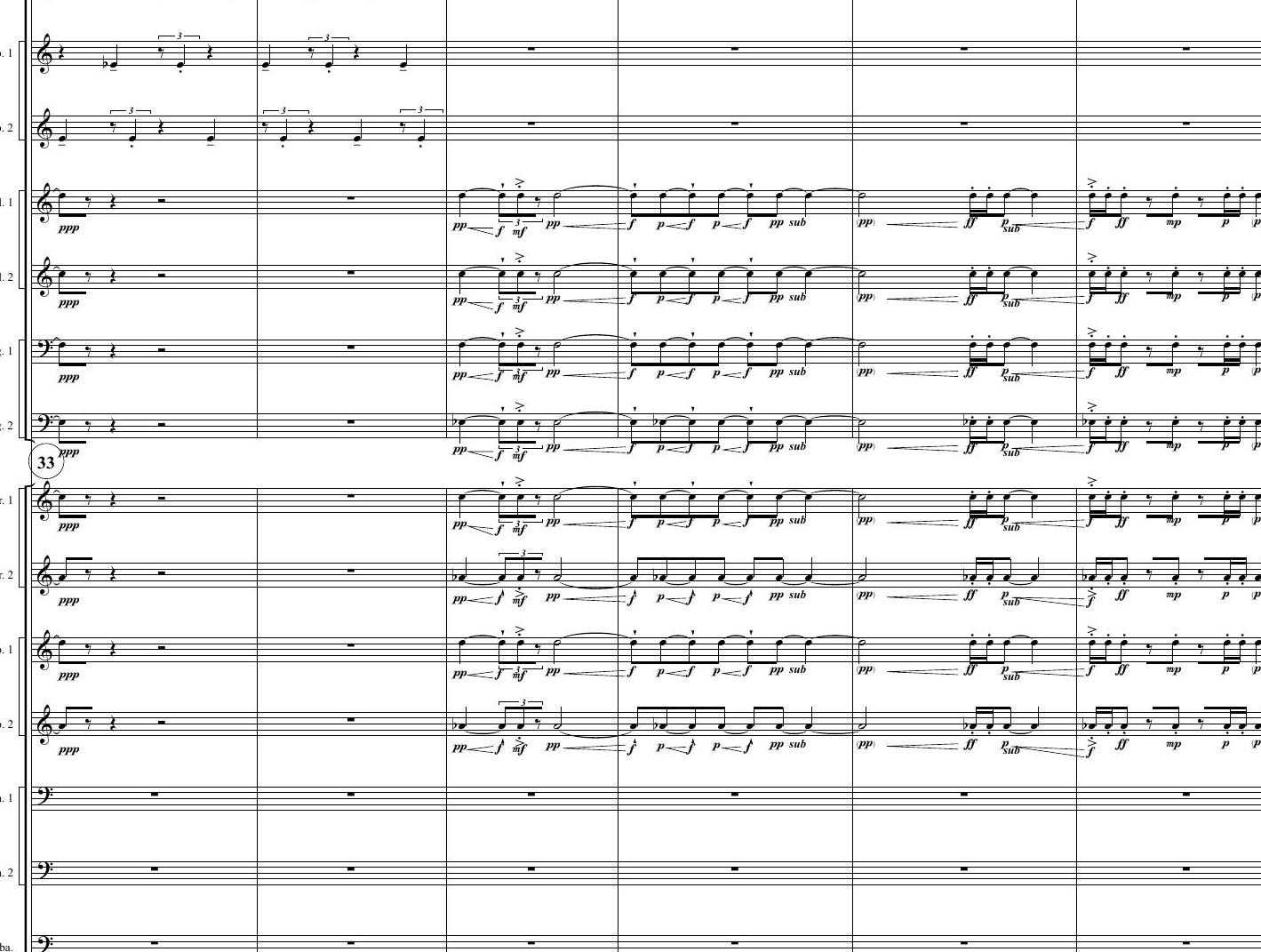
Autopoiesis
OrchestraOrquesta · 2003 · 14:25
Autopoiesis: a living system that continuously produces and maintains itselfAutopoiesis: un sistema vivo que se produce y se mantiene a sí mismo continuamente
The term autopoiesis was proposed by Chilean biologists Humberto Maturana and Francisco Varela in order to designate the organization of live systems. A brief description of the concept might be to state that autopoiesis is the condition of existence of all living systems in the continuous production of themselves.
According to Maturana and Varela, autopoietic systems present a network of processes and operation that defines them and make them distinguishable from others, and they can create and destroy their own elements, as a response to external perturbations. Even when the system changes its structure, this network remains invariable, preserving the system's identity. Living beings are in particular molecular autopoietic systems, and they remain alive only when they are in autopoiesis.
In my piece Autopoiesis, the formal structure of the work is inspired in a continuous process of self generation and destruction of the sound material that gives forms to the musical discourse.
El término autopoiesis fue propuesto por los biólogos chilenos Humberto Maturana y Francisco Varela para designar la organización de los sistemas vivos. Una descripción breve del concepto sería decir que la autopoiesis es la condición de existencia de todo sistema vivo en la producción continua de sí mismo.
Según Maturana y Varela, los sistemas autopoiéticos presentan una red de procesos y operaciones que los define y los hace distinguibles de otros, y pueden crear y destruir sus propios elementos como respuesta a perturbaciones externas. Aun cuando el sistema cambia su estructura, esa red permanece invariable y preserva la identidad del sistema. Los seres vivos son, en particular, sistemas autopoiéticos moleculares, y permanecen vivos solo mientras están en autopoiesis.
En mi obra Autopoiesis, la estructura formal está inspirada en un proceso continuo de autogeneración y destrucción del material sonoro que da forma al discurso musical.
Science & mathematicsCiencia y matemáticas
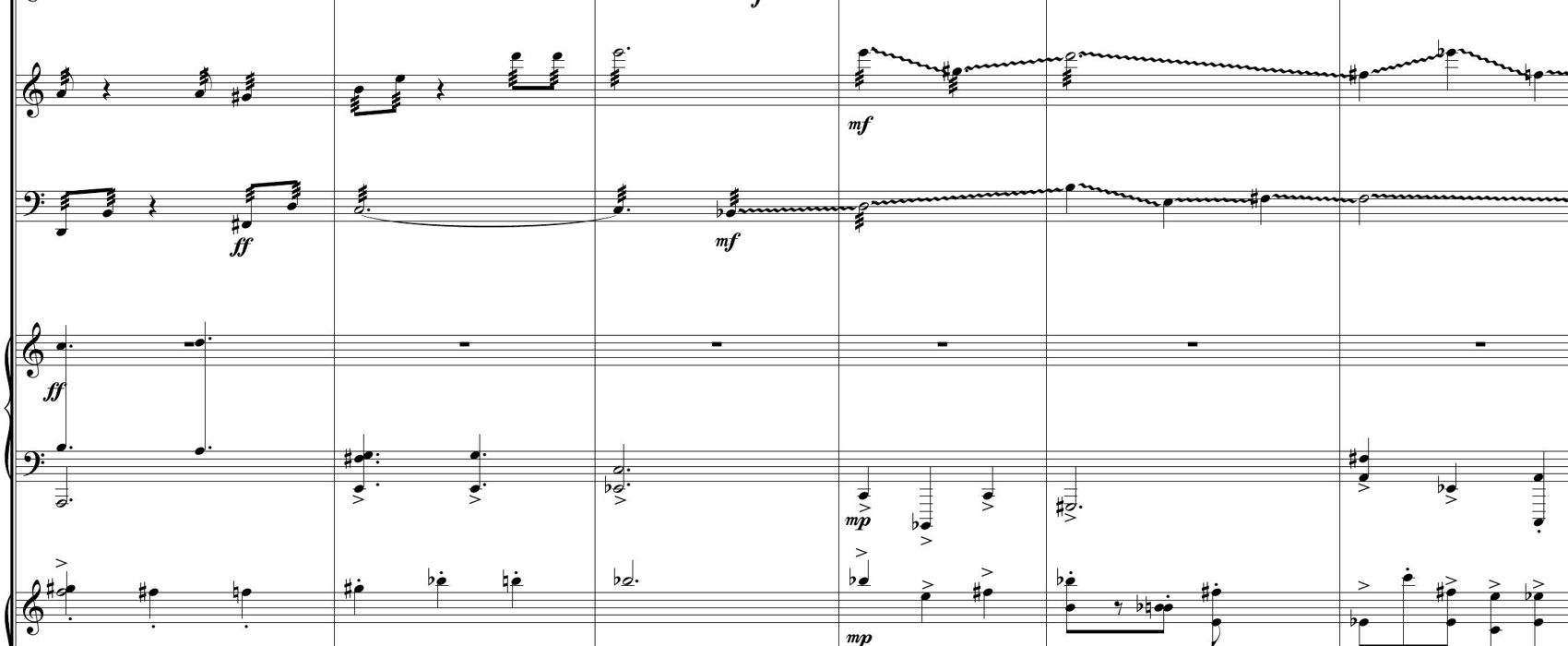
Pedesis
Flute, violin, violoncello, piano and vibraphoneFlauta, violín, violoncello, piano, vibráfono · 2017 · 7:43
Pedesis: the random walk of particles suspended in a fluid: Brownian motionPedesis: el paseo aleatorio de partículas suspendidas en un fluido: movimiento browniano
Science & mathematicsCiencia y matemáticas
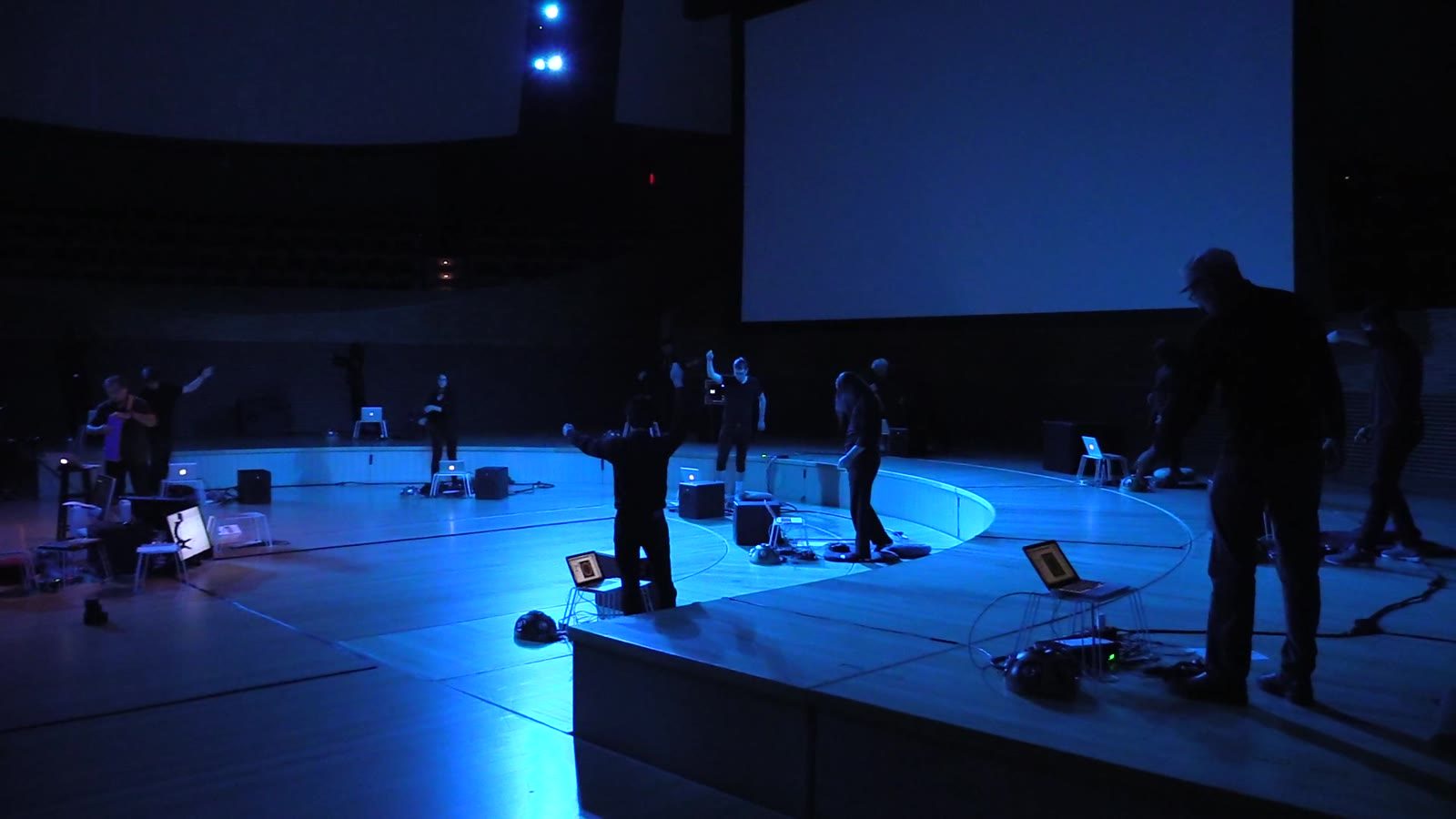
Orbitae
Arcontinuo and laptop orchestraArcontinuo y orquesta de Laptops · 2018 · 10:01
Orbits: bodies moving in orbital, sinusoidal motionÓrbitas: cuerpos en movimiento orbital y sinusoidal
Science & mathematicsCiencia y matemáticas
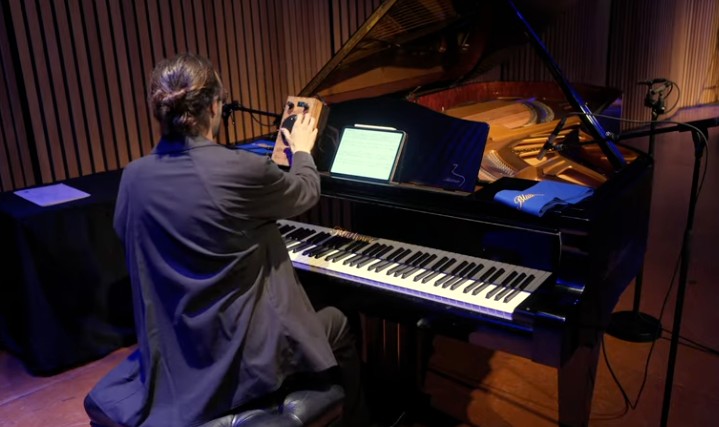
Chiral
Two pianos and ring modulatorsDos pianos y moduladores en Anillo · 2025 · 25:00
Chirality: a form and its mirror image, which cannot be superimposed on itQuiralidad: una forma y su imagen especular no superponible
Chiral is a work in twelve movements for two pianos and two ring modulators. Chirality, the property of a form that cannot be superimposed on its mirror image, as a left hand cannot be superimposed on a right hand, is its compositional premise.
The electronic setup follows the one Stockhausen devised for Mantra (1970), in which the sound of each piano passes through its own ring modulator. The modulators were designed and built at UC by a research team led by the composer from the study of the MODUL 69 B built for Mantra: analog processing with precise digital control, portable and reproducible. The research, with Tomás Koljatic, Michel Rozas, Cristián Garcés and Juan Parra Cancino, was presented at the International Computer Music Conference 2024 in Seoul and at the IRCAM Forum 2025 in Paris; the piece would not exist without it.
Each of the twelve movements has its own pair of modulation frequencies, one for each piano, stored as a preset that each pianist selects on the modulator before the movement begins. The frequencies range from about 8 Hz, below the threshold of pitch, to above 8 kHz. Microphones on each piano feed its modulator. A Max patch with the same frequencies can replace the hardware.
The composition of the work and the design and construction of the modulators were funded by an ArteCiH grant from the Dirección de Artes y Cultura, Vicerrectoría de Investigación, Pontificia Universidad Católica de Chile.
Chiral es una obra en doce movimientos para dos pianos y dos moduladores en anillo. La quiralidad, propiedad de una forma que no puede superponerse a su imagen especular, como una mano izquierda no puede superponerse a una derecha, es su premisa compositiva.
La electrónica sigue el dispositivo que Stockhausen concibió para Mantra (1970), en que el sonido de cada piano pasa por su propio modulador en anillo. Los moduladores fueron diseñados y construidos en la UC por un equipo de investigación dirigido por el compositor a partir del estudio del MODUL 69 B construido para Mantra: procesamiento analógico con control digital preciso, portátil y reproducible. La investigación, junto a Tomás Koljatic, Michel Rozas, Cristián Garcés y Juan Parra Cancino, se presentó en la International Computer Music Conference 2024 en Seúl y en el IRCAM Forum 2025 en París; la obra no existiría sin ella.
Cada uno de los doce movimientos tiene su propio par de frecuencias de modulación, una para cada piano, guardado como un preset que cada pianista selecciona en su modulador antes de comenzar el movimiento. Las frecuencias van desde unos 8 Hz, bajo el umbral de la altura, hasta más de 8 kHz. Micrófonos en cada piano alimentan su modulador. Un patch de Max con las mismas frecuencias puede reemplazar el hardware.
La composición de la obra y el diseño y la construcción de los moduladores fueron financiados por un fondo ArteCiH de la Dirección de Artes y Cultura, Vicerrectoría de Investigación, Pontificia Universidad Católica de Chile.
Science & mathematicsCiencia y matemáticas
Tessellae
Percussion and live electronicsPercusión y electrónica en vivo · 2026 · 10:00
Tessellae: the small tiles of a mosaic; rhythm as tessellationTessellae: las pequeñas piezas de un mosaico; el ritmo como teselación
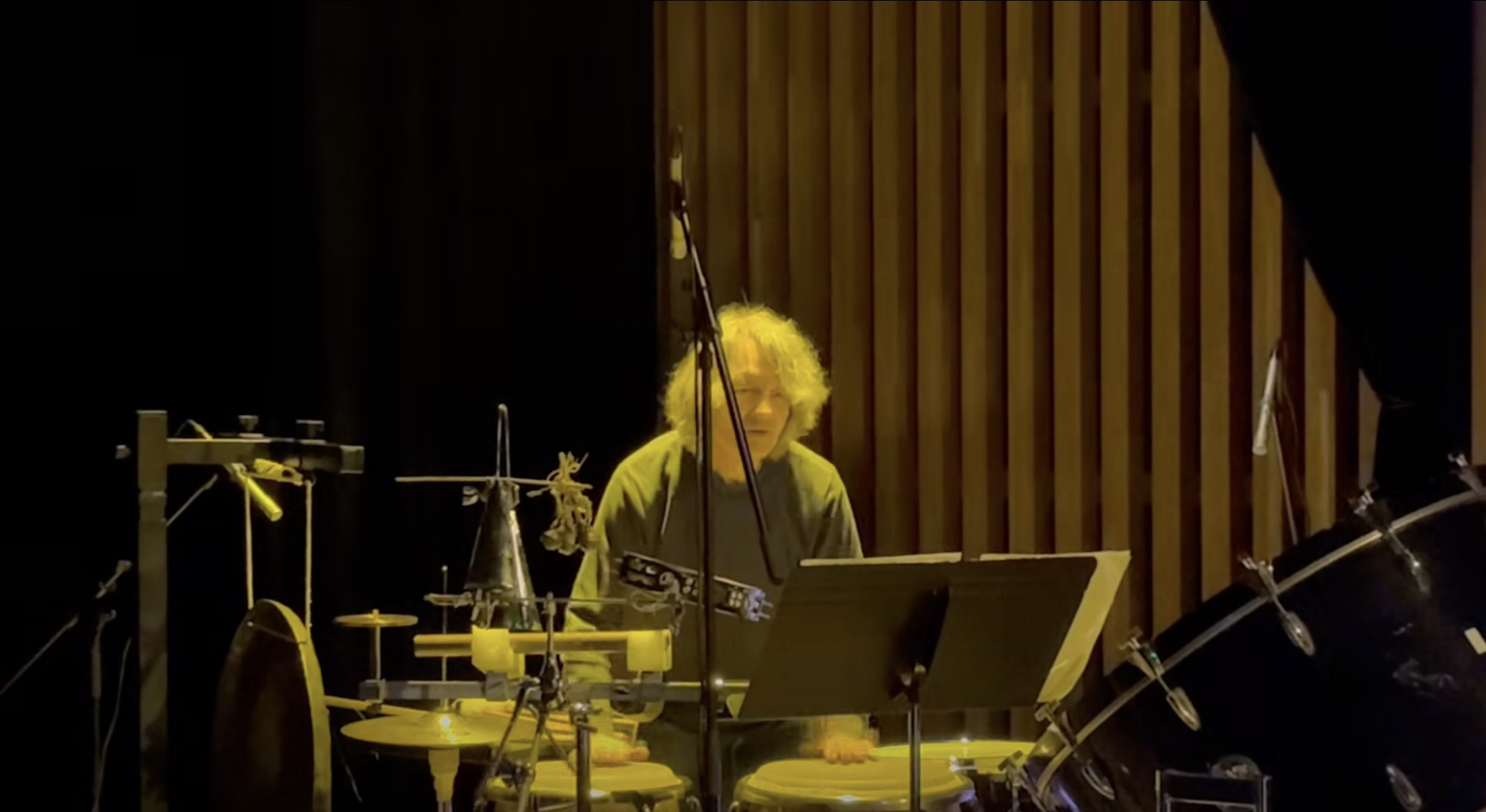
Small rhythmic tiles laid in time by a single performer, built on Euclidean rhythms: patterns in which events are spread as evenly as possible across a cycle. The grid is then expanded with asymmetric tuplets in threes and fives, with repetition and with silence; one or two lines sound at a time, so every gesture reads as a discrete tessera.
The live electronics use RAVE, a variational autoencoder developed at IRCAM that runs in real time, trained on percussion, which listens to the performer and reshapes the timbre in the moment. The AI does not compose: it transforms what is played, as it is played. The piece lives in the dialogue between a strict rhythmic architecture and a fluid transformation of its surface.
Percussion setup: hi hat, snare drum, bass drum, brake drum, tam tam, triangle, crotales, sleigh bells, tambourine, agogô, cowbell, wood blocks and congas. The score has eight sections, among them Colorful, Calm, Solemn, Serene, Ceremonial and Furious; the electronics advance through cues marked in the part.
Pequeñas teselas rítmicas dispuestas en el tiempo por un solo intérprete, construidas sobre ritmos euclidianos: patrones en que los eventos se reparten de la manera más pareja posible dentro de un ciclo. Esa grilla se expande luego con tresillos y quintillos asimétricos, con repetición y con silencio; suenan una o dos líneas a la vez, de modo que cada gesto se lee como una tesela discreta.
La electrónica en vivo usa RAVE, un autoencoder variacional en tiempo real desarrollado en el IRCAM y entrenado con percusión, que escucha al intérprete y remodela el timbre en el momento. La inteligencia artificial no compone: transforma lo que se toca, mientras se toca. La obra vive en el diálogo entre una arquitectura rítmica estricta y una transformación fluida de su superficie.
Instrumentación de percusión: hi hat, caja, bombo, brake drum, tam tam, triángulo, crótalos, cascabeles, pandereta, agogó, cencerro, wood blocks y congas. La partitura tiene ocho secciones, entre ellas Colorful, Calm, Solemn, Serene, Ceremonial y Furious; la electrónica avanza por cues marcados en la parte.
Science & mathematicsCiencia y matemáticas
Signals Beneath
Multichannel sound sculpture installationInstalación escultórico sonora multicanal · 2022
Sonification: the ground itself made audibleSonificación: la tierra misma hecha audible
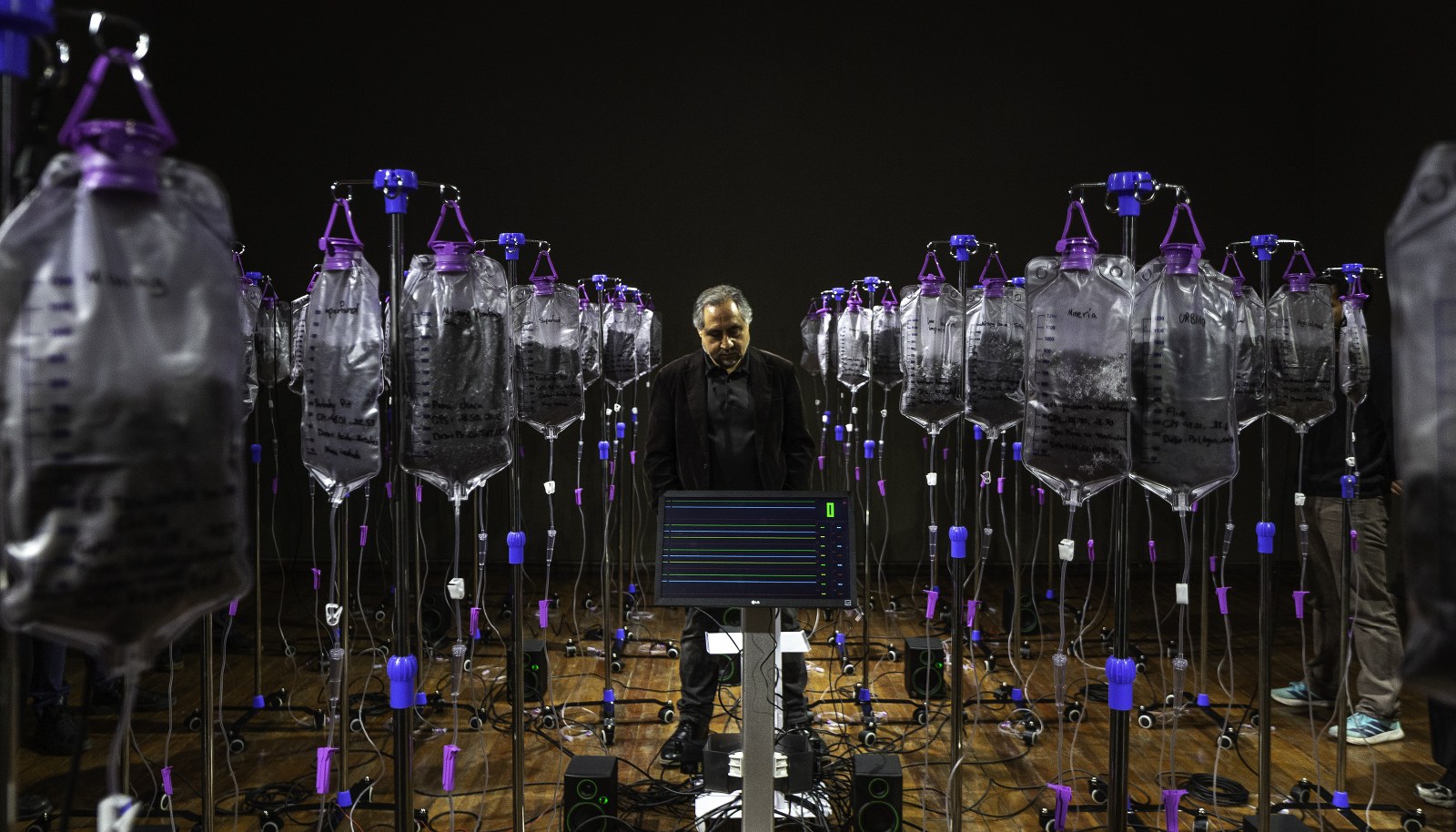
Forty suspended IV bags hold soil sampled across Chile, from remote territories to extractive and industrial sites, each bag etched with its own laboratory data. Contact microphones and custom data sonification give every bag a singular voice; touch and presence activate an evolving multichannel field. At the center, a vital signs monitor turns those signals into waveforms: soil registering stress and depletion like a living body.
An ongoing collaboration with the artists Pedram Baldari and Nooshin Hakim Javadi, developed since 2022 and preceded by Diatomic Variations (2024, Weisman Art Museum). Listening here is ecological attention: data made embodied rather than abstract.
Cuarenta bolsas de suero suspendidas contienen tierra recogida a lo largo de Chile, desde territorios remotos hasta sitios industriales y extractivos, cada una grabada con sus propios datos de laboratorio. Micrófonos de contacto y una sonificación de datos hecha a medida le dan a cada bolsa una voz singular; el tacto y la presencia activan un campo multicanal en evolución. En el centro, un monitor de signos vitales convierte esas señales en formas de onda: la tierra registrando estrés y agotamiento como un cuerpo vivo.
Una colaboración en curso con los artistas Pedram Baldari y Nooshin Hakim Javadi, desarrollada desde 2022 y precedida por Diatomic Variations (2024, Weisman Art Museum). Escuchar es aquí una forma de atención ecológica: el dato hecho cuerpo, no abstracción.
Science & mathematicsCiencia y matemáticas
De Natura Organica
OrganOrgano · 2016 · 1:10:04
L systems: recursive rewriting rules that model the growth of plantsSistemas L: reglas recursivas de reescritura que modelan el crecimiento de las plantas
De Natura Organica was written for the organist Alejandro Reyes. The title plays on two natures: the imposing nature of the organ as a versatile instrument that is relatively absent from contemporary music, and the nature of this music itself, inspired by biological and organic processes that simple computer algorithms model well.
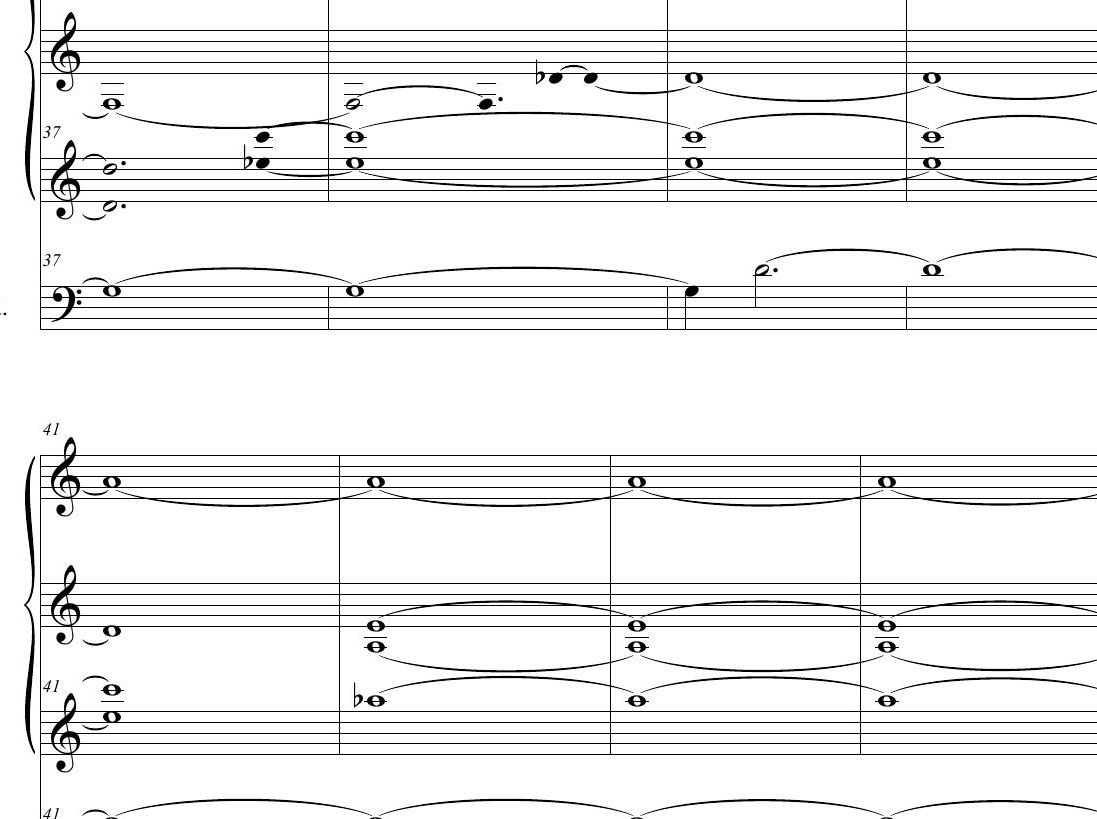
The music was generated entirely by compositional methods based on L systems, originally proposed by the Dutch botanist Aristid Lindenmayer in 1968 as an axiomatic system for modelling growth and development in biological structures such as plants and trees. L systems work through a parallel substitution string rewriting model, in a way very similar to Chomsky grammars, and can successfully simulate morphogenesis. An L system algorithm generated the cover art of the album as well. Composers have used them since the eighties.
The work is structured in seven movements, each one created by a different variant of an L system. Movement two contains three submovements that differ mostly in instrumentation, and movement four contains two. The recording suggests a listening order, but each movement is autonomous and the whole work can be heard in any order. It was recorded on the digital organ of the Templo Mayor at Campus Oriente of the Pontificia Universidad Católica de Chile, with funding from the Dirección de Artes y Cultura UC.
De Natura Organica fue compuesta especialmente para el maestro Alejandro Reyes. El título propone un juego entre la naturaleza imponente del órgano, un instrumento de gran versatilidad y relativamente poco usado en la música contemporánea, y la naturaleza propia de esta música, inspirada en procesos biológicos y orgánicos que pueden modelarse muy bien mediante algoritmos computacionales simples.
La música fue generada íntegramente mediante métodos composicionales basados en sistemas L, propuestos originalmente por el botánico holandés Aristid Lindenmayer en 1968 como un sistema axiomático para modelar el crecimiento y desarrollo de estructuras biológicas como plantas y árboles. Los sistemas L funcionan mediante un modelo de sustitución de caracteres en paralelo, de forma similar a las gramáticas de Chomsky, y simulan la morfogénesis con éxito. La carátula del disco fue generada con este mismo tipo de algoritmos. Se usan para crear música desde los años ochenta.
La obra se estructura en siete movimientos, cada uno generado a partir de una variante distinta de sistema L. El movimiento 2 contiene tres submovimientos que difieren sobre todo en su instrumentación y el 4 contiene dos. El disco propone un orden de escucha, pero cada movimiento es autónomo y la obra puede ordenarse de cualquier manera. Fue grabada en el órgano digital del Templo Mayor del Campus Oriente de la Pontificia Universidad Católica de Chile, con financiamiento de la Dirección de Artes y Cultura UC.
Science & mathematicsCiencia y matemáticas
Túneles
Tenor saxophoneSaxofón tenor · 2002 · 5:57
Quantum tunneling: a particle crossing a barrier it should not crossEfecto túnel cuántico: una partícula que atraviesa una barrera que no debería poder cruzar
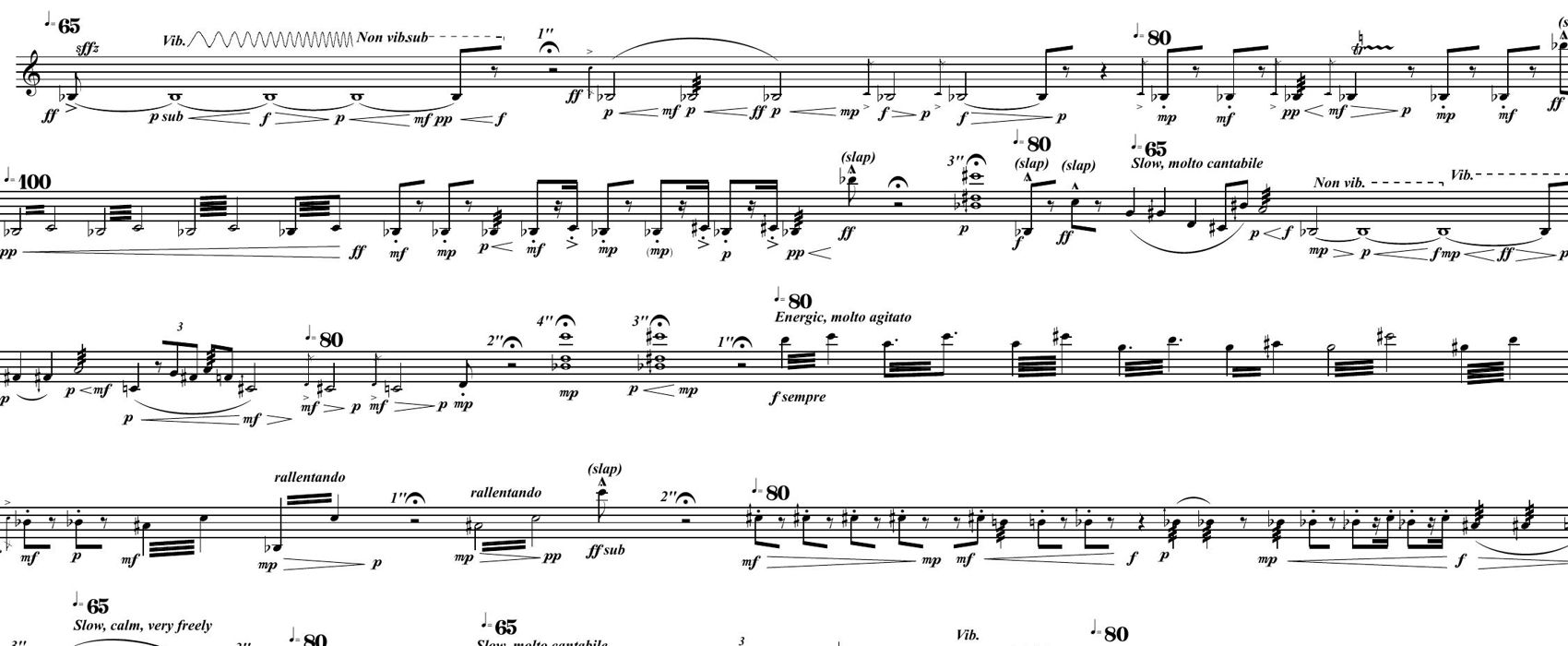
Túneles is inspired by a quantum mechanics effect called "quantum tunneling", consisting on the ability of a particle to cross (or tunnel through) a potential energy barrier where classical physics would conclude that the particle did not have enough energy to do so. This is due to the wave nature of particles at the quantum level: there will always be a finite probability of finding the particle on the other side of the barrier unless this is infinitely high or wide. Musically, in Túneles, certain events with "higher" energy (in terms of loudness, pitch or other properties) than the average events just happen from nowhere, with no preparation or anticipation, similarly to the quantum tunneling effect, and this constitutes the driving force of the piece. As the piece progresses, these events dominate, creating a "higher" overall energy level towards the end. Thus, the macroform of the piece could be described as a shift from one energy level to another, produced by different "musical tunnels" that happen in the music. Túneles was premiered by Masahito Sugihara on May 2005 at the Block Museum of Art, at the Northwestern University New Music Marathon contemporary music festival, in Evanston, Illinois, USA.
Túneles está inspirada en un efecto de la mecánica cuántica llamado "efecto túnel", que consiste en la capacidad de una partícula de atravesar una barrera de energía potencial que, según la física clásica, no tendría energía suficiente para cruzar. Esto se debe a la naturaleza ondulatoria de las partículas en el nivel cuántico: siempre habrá una probabilidad finita de encontrar la partícula al otro lado de la barrera, a menos que esta sea infinitamente alta o ancha.
Musicalmente, en Túneles ciertos eventos de energía "más alta" que el promedio, en términos de intensidad, altura u otras propiedades, aparecen de la nada, sin preparación ni anticipación, de manera análoga al efecto túnel, y eso constituye la fuerza motriz de la obra. A medida que la pieza avanza esos eventos dominan y crean un nivel de energía general "más alto" hacia el final. La macroforma puede describirse, así, como un desplazamiento de un nivel de energía a otro, producido por distintos "túneles musicales".
Túneles fue estrenada por Masahito Sugihara en mayo de 2005 en el Block Museum of Art, en el New Music Marathon de Northwestern University, en Evanston, Illinois.
Science & mathematicsCiencia y matemáticas
String Spells I
Clarinet, gametrak and electronicsClarinete, gametrak y electrónica · 2024 · 10:00
Motion as the driving force of the pieceEl movimiento como fuerza motriz de la obra
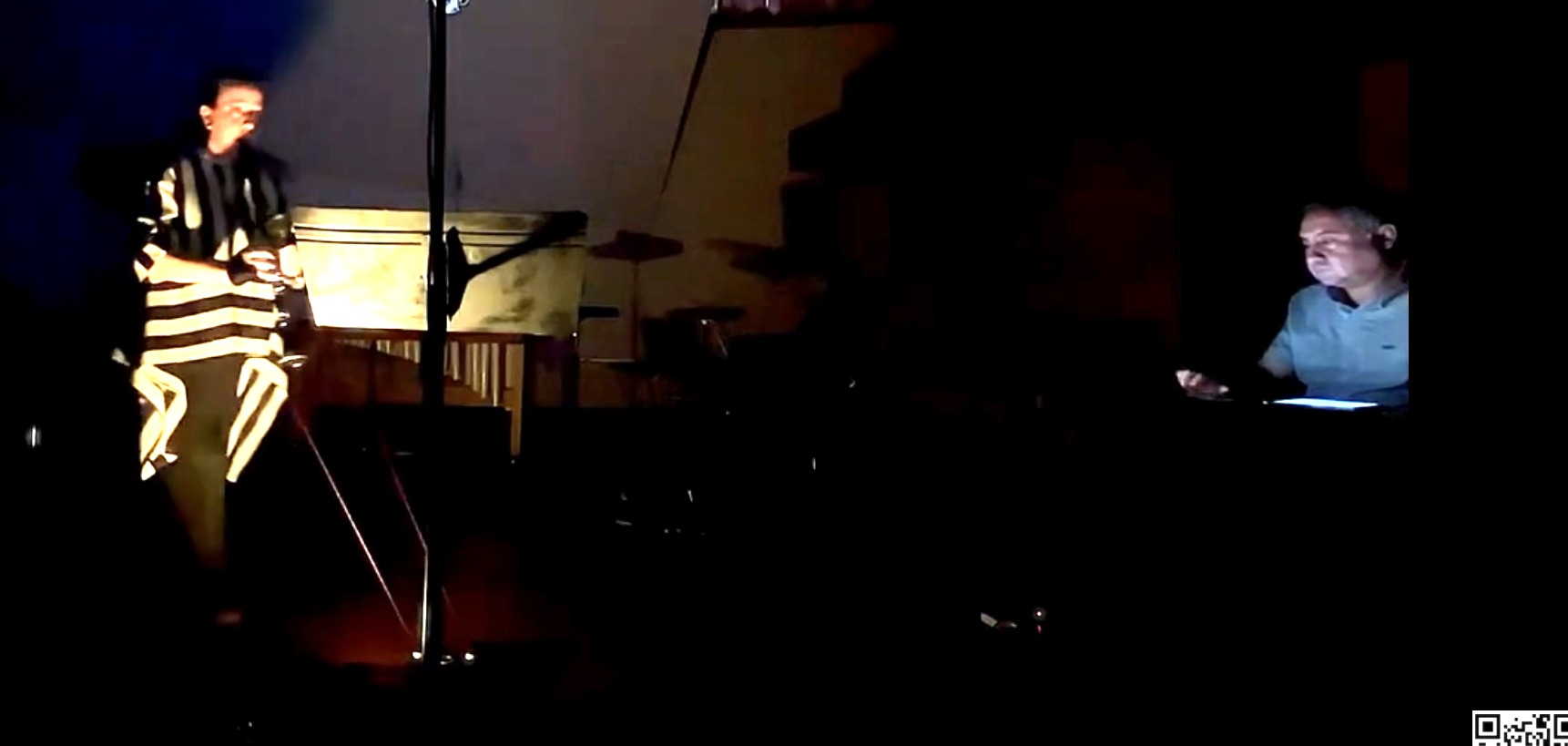
String Spells I, for clarinet, Gametrak and live electronics, was written for the clarinetist Elisabeth Stimpert. A Gametrak controller captures the performer's movements in space, and those movements shape the live electronics: gesture becomes a musical cause alongside the sound of the instrument.
The Gametrack, a game controller with two retractable cables attached to the performer's hands, measures the position of each hand in three dimensions. The score notates these movements alongside the clarinet part: circles around the long notes, "like stirring a potion", spirals, and steps away from the controller and back. Its sections are marked Bewitching, Lingering and Urgent.
String Spells I, para clarinete, gametrak y electrónica en vivo, fue escrita para la clarinetista Elisabeth Stimpert. Un controlador gametrak registra los movimientos del intérprete en el espacio, y esos movimientos modelan la electrónica en vivo: el gesto se vuelve causa musical junto al sonido del instrumento.
El gametrak, un controlador de videojuegos con dos cables retráctiles sujetos a las manos del intérprete, mide la posición de cada mano en tres dimensiones. La partitura anota esos movimientos junto a la parte de clarinete: círculos alrededor de las notas largas, "como revolviendo una poción", espirales, y pasos que alejan al intérprete del controlador y lo devuelven. Sus secciones llevan las indicaciones Bewitching, Lingering y Urgent.